· Cole Harmon
The Best Wood for Carving, From a Beginner's Bench
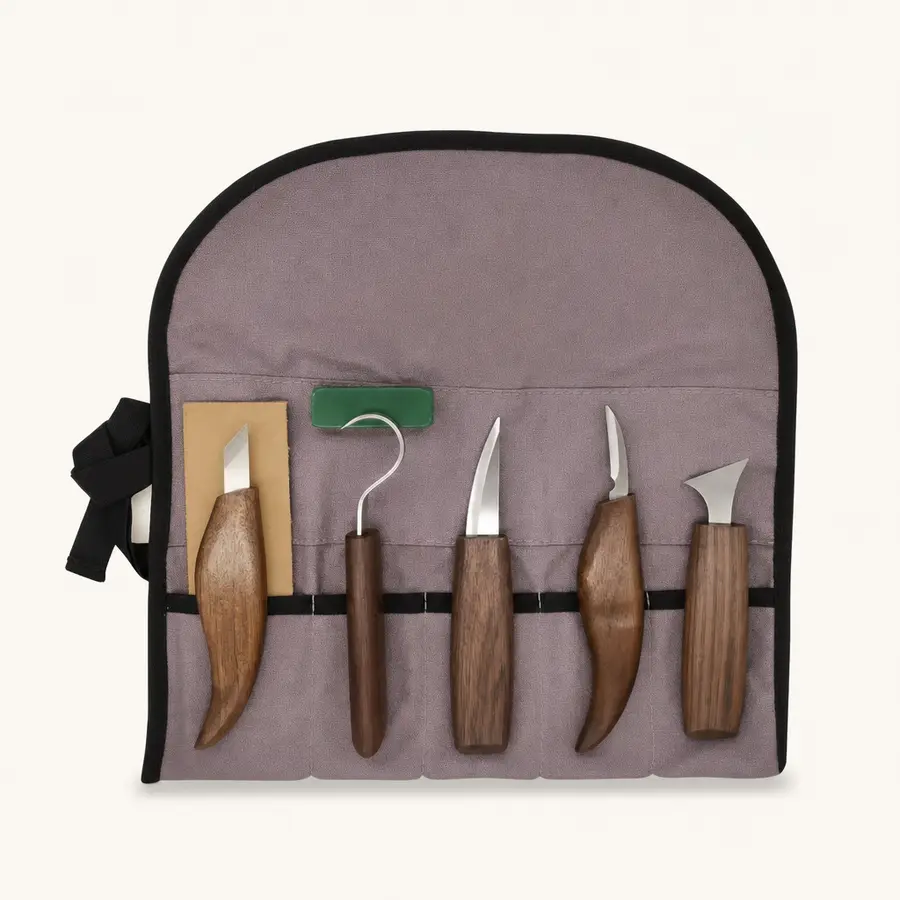
Ask ten carvers what ruined their first project and most won't blame the knife — they'll blame the wood. A blade that glides through basswood will skate off oak, tear pine, and stall in a knot. Choosing whittling wood is not a detail; it's half the experience. This guide covers the three woods worth knowing as a beginner — basswood, butternut, and pine — plus the ones to avoid, where to actually buy carving blocks, and how the wood you choose interacts with the blades in your wood carving kit.
Why the wood matters as much as the knife
Two properties decide almost everything. Hardness — measured species by species in the USDA Forest Service's Wood Handbook, the standard reference for wood mechanical properties — determines how much pressure a cut needs — and every extra pound of pressure costs you control. Grain determines whether the wood slices or tears: straight, fine, even grain cuts predictably, while wavy or alternating grain switches direction mid-stroke and lifts splinters where you wanted a clean surface. Basswood scores well on both, which is why it has been the default teaching wood for generations of carvers — common practice, not marketing.
Basswood: the beginner standard
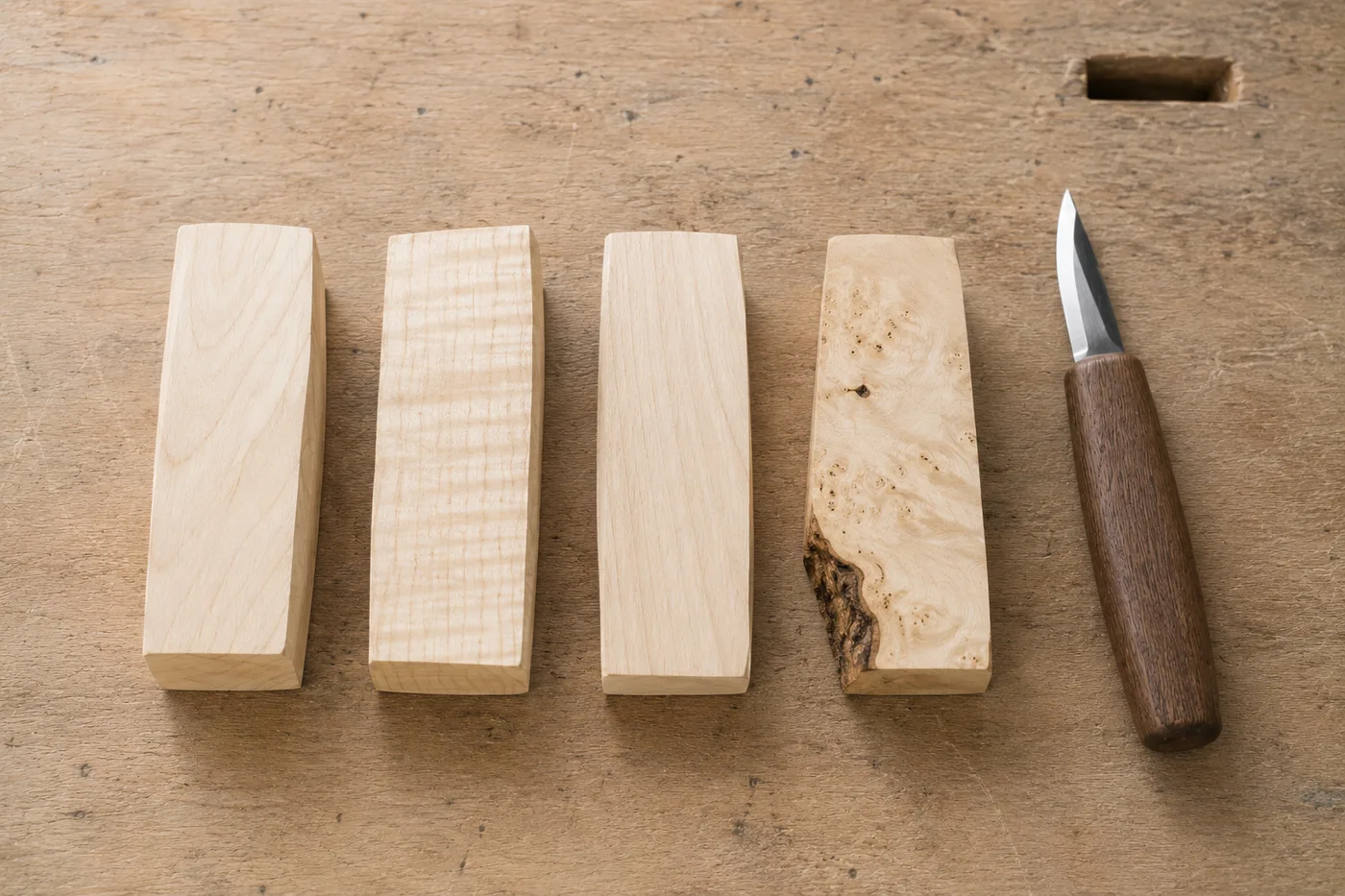
Everything about basswood is forgiving. It has little figure and few knots, so a cut behaves the same on Tuesday as it did on Monday. It's soft enough that a freshly stropped whittling knife pushes through with fingertip pressure, yet it doesn't fuzz or collapse the way very soft softwoods can — chip carving notches stay crisp, and small details like a gnome's hat brim survive handling. Its pale, even color also takes paint and wood-burning well, which matters if your carvings are headed for a shelf.
The trade-off is character: basswood is bland by design. No dramatic grain, no rich color. For learning, that's a feature — you want the wood quiet so your knife work is the loudest thing in the room.
Butternut: the step-up wood
Where basswood is a practice canvas, butternut is a display wood. It carves nearly as easily, and the satiny, honey-toned surface it leaves behind often needs nothing more than a coat of oil. The coarser, more open grain is the catch: a slightly dull blade that would still get away with it in basswood will start tearing fibers in butternut, so your stropping habit matters more here. Availability is the other caveat — craft stores rarely stock it, so you're looking at lumber yards, specialty hardwood dealers, or online carving suppliers.
Pine: cheap, everywhere, and a little frustrating
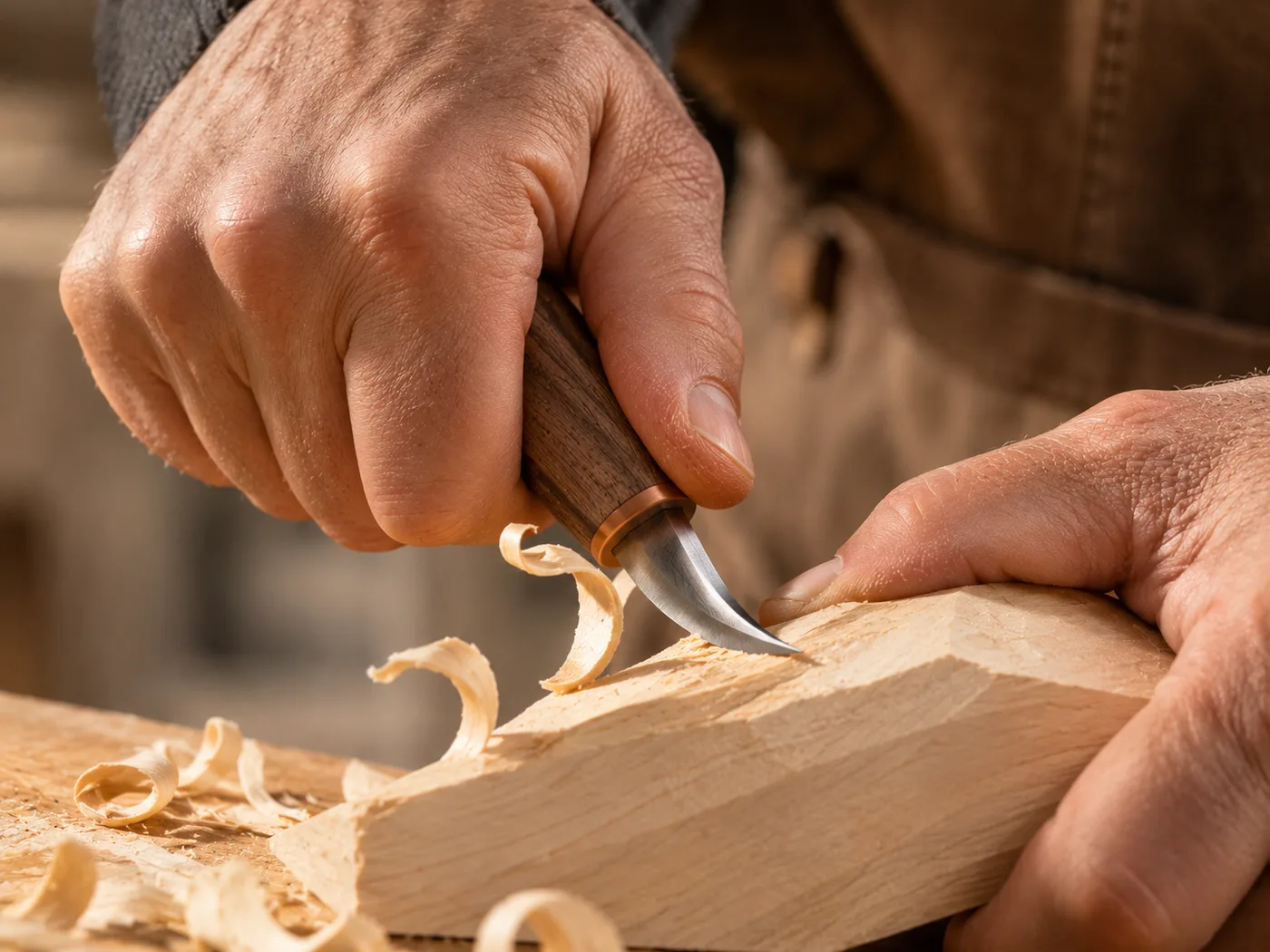
Pine's appeal is obvious: a home center sells it by the board for pocket change, and a scrap bin fills your practice needs for free. The frustration comes from its structure. Each growth ring is a stripe of soft early wood next to a stripe of harder late wood, so a knife stroke crossing the rings speeds up and slams down alternately — exactly what a beginner's hands don't need. Sap can also gum up a blade mid-session. If pine is what you have, white pine varieties are generally the mildest carving companions, and long push cuts along the grain behave far better than detail work across it. It's a warm-up wood, and there's no shame in that.
The three woods at a glance
| Wood | Relative hardness | Grain | Best for | Where to find it |
|---|---|---|---|---|
| Basswood | Softest of the three; cuts with hand pressure | Fine, straight, nearly invisible | Learning, detail work, painted pieces | Craft stores (pre-cut block packs), online |
| Butternut | Soft, slightly firmer than basswood | Visible, warm, coarser and more open | Display pieces finished with oil | Lumber yards, hardwood dealers, online |
| Pine | Varies — soft and hard bands alternate | Pronounced rings, can tear; sometimes resinous | Free practice, roughing out, sticks | Home centers, scrap bins, everywhere |
Woods to skip while you're learning
None of these are forever bans — plenty of carvers graduate to cherry or walnut once their stop cuts land where they aim. But each of them, early on, converts carving from a controlled slice into a shoving match. The treated-lumber point is the one to take seriously rather than personally: common practice among carvers is to treat any wood of unknown origin — painted, stained, green-tinted, or salvaged from pallets — as not worth the risk when a clean basswood block costs a couple of dollars.
A note on green wood and spoons
One useful exception to "buy dry blocks": spoon carvers often prefer green (freshly cut, still moist) wood, because the moisture makes hollowing dramatically easier. If a neighbor prunes a birch or fruit tree, a wrist-thick branch is a free spoon blank. The kit's hook knife is the blade built for exactly that job — the curved edge scoops the bowl while the sloyd shapes the handle. One of our Korean buyers summed up the force equation better than we could: "When cutting wood, the blade is sturdy and the large handle is comfortable for applying force." Softer or greener wood simply means you need less of that force.
Where to actually buy carving wood
A practical tip that saves beginners money: buy small. A bag of palm-sized basswood blocks outlasts a month of evening carving, teaches you more than one big board, and wastes nothing when a project goes sideways. When you pick blocks by hand, look for pale, even color, ends free of cracks, and faces without knots — a thirty-second inspection that decides how pleasant the next ten hours of carving will be.
CarveKind kits sold to date — and basswood blocks are the wood we point every first-time buyer toward
— CarveKind sales data, 2026
Matching the wood to your blades
Whatever wood you choose, the edge has to be ready for it. The chrome vanadium blades in the CarveKind carving knife kit arrive sharp — buyers mention it constantly in our reviews — but every wood, even soft basswood, wears an edge down through simple use. A minute on the grinding leather with the green polishing wax before each session keeps hand pressure low, and low pressure is what makes soft woods feel soft. If you're still deciding which blade does what, the wood carving tools guide covers all five, and wood carving for beginners covers the cuts themselves. Then pick a project from easy whittling projects and put the block to work.

Cole Harmon · Hobbyist Woodcarver & Hand-Tool Reviewer, 8 yrs
Cole has spent eight years carving with hand tools — sloyd knives, hook knives, strops and sharpening gear.
Written by Cole Harmon.