· Cole Harmon
Wood Carving for Beginners: How to Actually Start
Beginner wood carving has a reputation problem: people picture a workshop full of chisels, mallets, and thirty years of muscle memory. The reality is closer to a park bench, one sharp knife, and a stick. This guide walks through what whittling for beginners actually looks like — which blade to pick up first, the handful of cuts that do almost all the work, the safety habits carvers build before anything else, and the first projects that teach you something instead of frustrating you.
What wood carving involves (and what it doesn't)
The word "carving" covers several styles, and it helps to know which one you're actually signing up for. Whittling is shaping wood with knife strokes alone — sticks, gnomes, little birds. Chip carving removes small triangular chips from a flat surface to build geometric patterns. Spoon carving hollows a bowl into the wood with a curved blade. All three are knife work, all three are beginner-accessible, and all three are covered by the five blades in a standard wood carving tool set — which is why kits exist in the first place.
What you don't need on day one: gouges, mallets, carving vises, or exotic hardwoods. Those belong to relief carving and sculpture, which are separate crafts you can grow into later. Starting with knife work keeps the cost low and the learning curve honest.
The five blades, and what each one is for
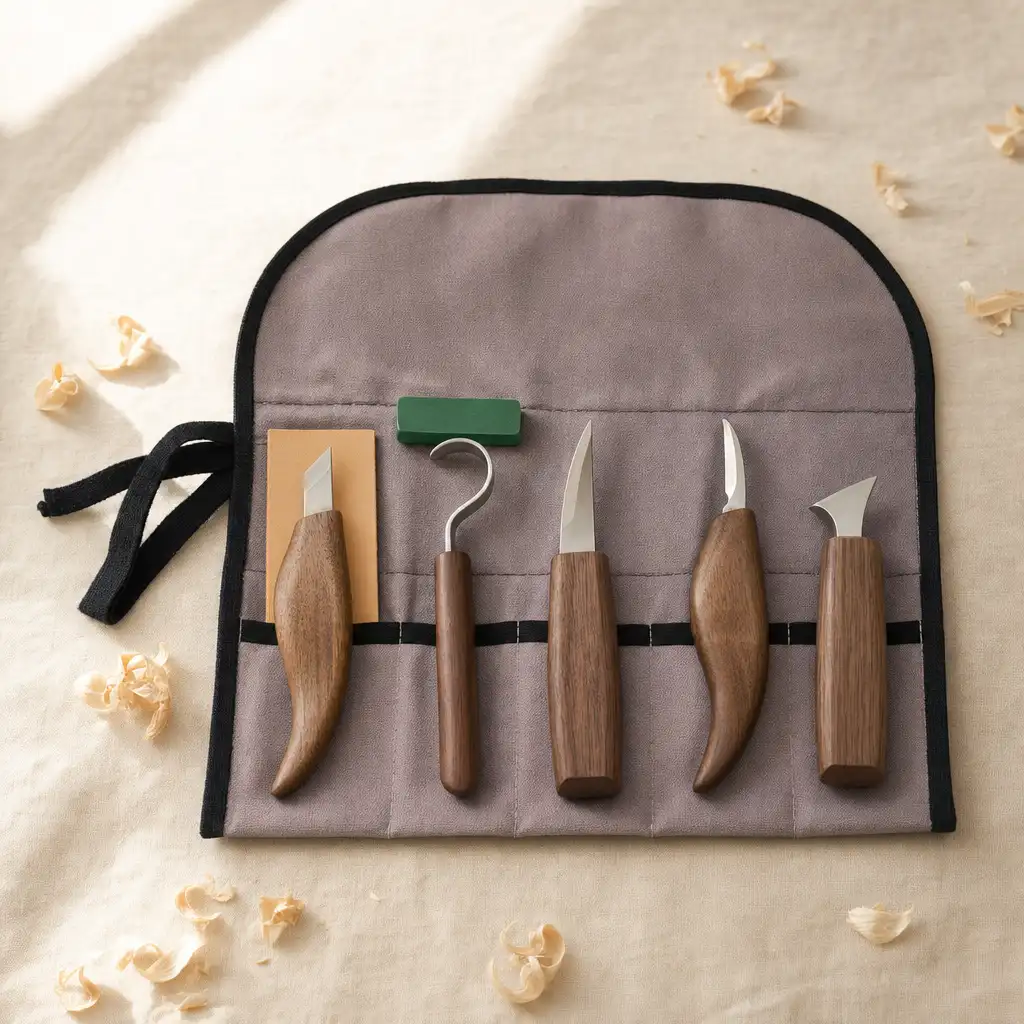
Our CarveKind carving knife kit follows exactly that logic: five chrome vanadium steel blades with black walnut handles, plus a leather strop and polishing wax to keep them sharp, all in a canvas roll bag. Here is what each blade does in practice:
| Blade | What it's for | First thing to try with it |
|---|---|---|
| Sloyd knife | General shaping and roughing out — the blade you'll hold 80% of the time | Long push cuts down a stick |
| Chip carving knife | Notches, triangular chips, fine detail lines | A row of V-notches on a flat scrap |
| Hook knife | Hollowing concave shapes — spoon bowls, small dishes | Scooping a shallow hollow in soft wood |
| Oblique knife | Angled slicing for clean lines and tight corners | Cleaning up the edges of a stop cut |
| Trimming knife | Short, controlled finishing cuts on small areas | Rounding the corners of a small block |
If you're deciding between buying blades individually or as a set, the math is on the wood carving kit page — but the short version is that a beginner rarely knows which specialist blade they'll need until the project demands it, which argues for having the set on hand.
Three cuts to learn before anything else
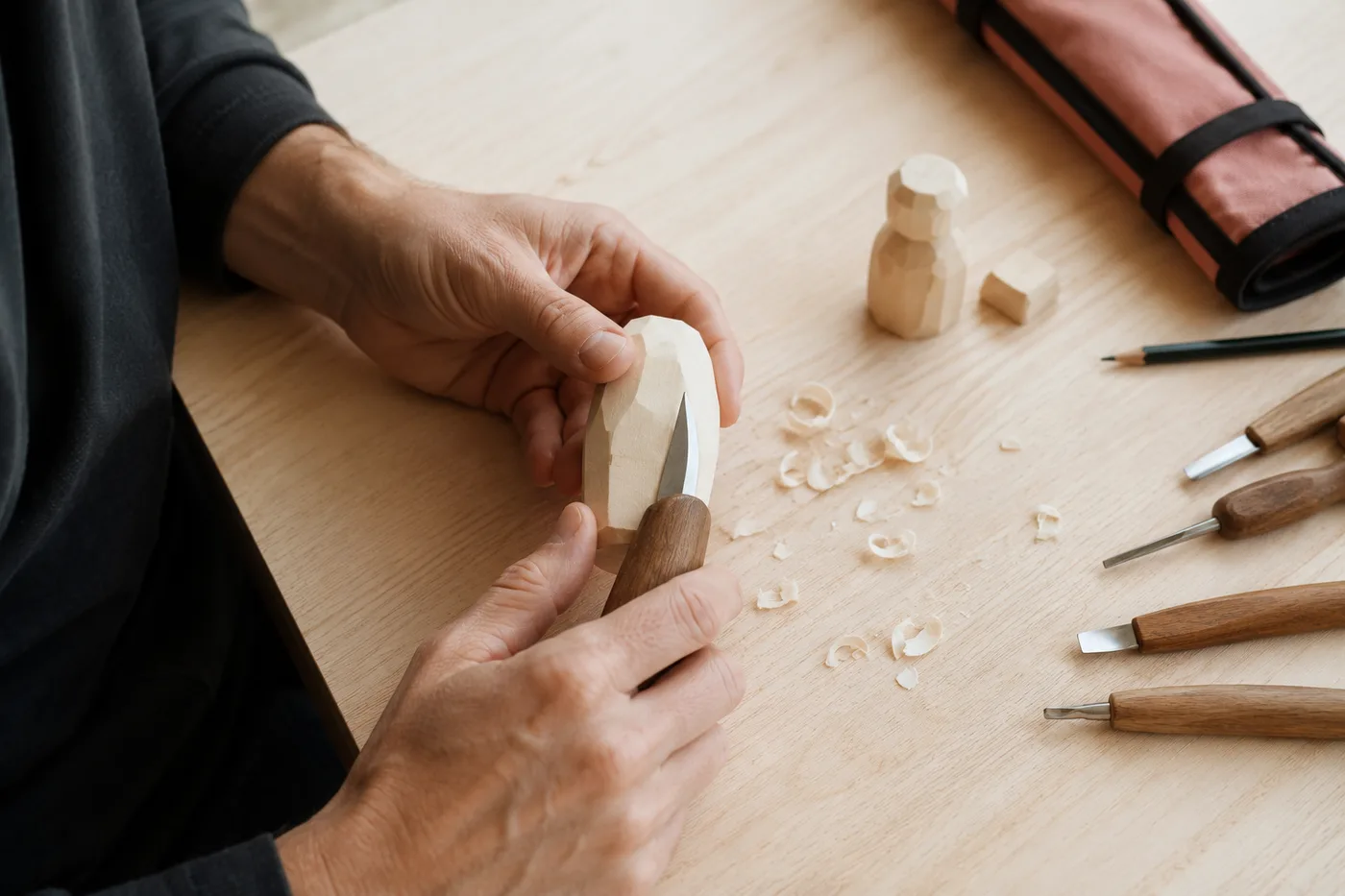
The push cut is the foundation. Hold the knife in your dominant hand, place the thumb of your other hand low on the back of the blade, and push the edge away from you through the wood in a slow, controlled slice. The off-hand thumb adds power and control; the direction — away from your body — adds safety. Long, thin shavings mean you're doing it right. Deep, forced bites mean you're asking too much of one stroke.
The stop cut is how you protect one part of the carving while removing wood next to it. Score a straight line down into the wood, then slice toward that line from the side; the chip pops out and the cut stops exactly where you scored. Every mushroom cap, gnome hat brim, and spoon shoulder starts as a stop cut.
The paring cut is a short, braced slice used for fine control — the same motion as peeling an apple, with the wrist doing small, deliberate work. Because it can draw the blade toward your thumb, common practice among carvers is to keep the thumb anchored below the cutting path or protected by a thumb guard, and to save this cut for when the push cut can't reach.
Safety habits carvers build first
None of this is about fear — a sharp knife under control is safer than a dull one being forced. Dull edges need more pressure, and more pressure is what turns a slip into a cut. That's why sharpening gear ships in the kit rather than being an accessory: a few passes on the grinding leather with polishing wax before each session keeps the edge keen enough to cut with light pressure.
A practical habit worth building from day one: inspect the package before reaching in, and unwrap each blade slowly by the handle. Sharp tools are sharp in the box, not just on the bench.
And to be clear about kids: these are knives, not toys. Some buyers carve alongside their teenagers, and supervised teens can learn well — but this is an adult's tool that gets shared, never a children's craft set.
Average rating across 192 verified buyer reviews of the CarveKind kit
— CarveKind verified buyer reviews, 2026
Your first wood and your first project
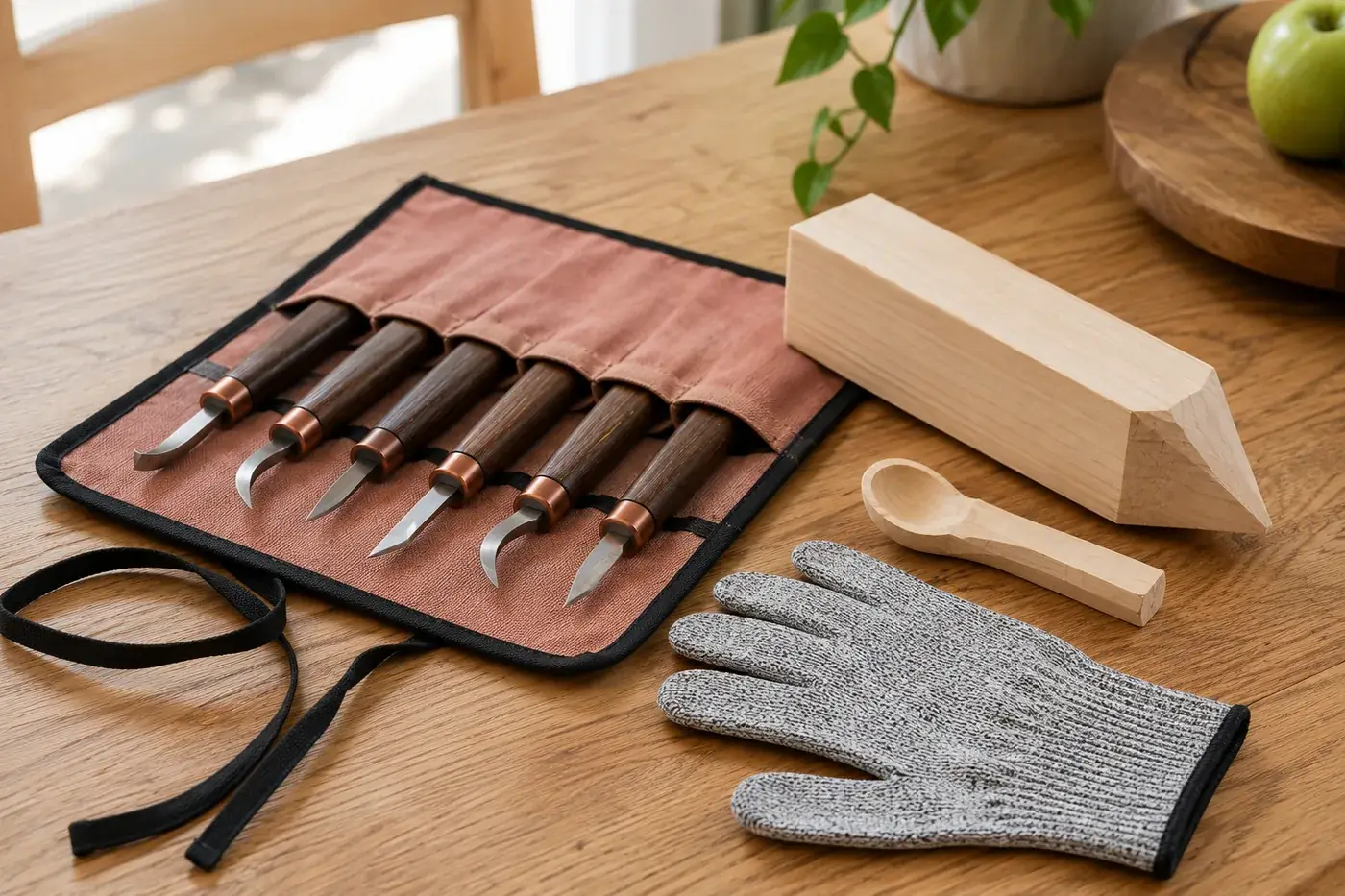
Wood choice matters more than beginners expect: the same knife that glides through basswood will fight you in oak. The best wood for carving sets basswood, butternut, and pine side by side — grain, relative hardness, where to buy each — and if you want a ranked list of starter carves with the exact blades each one uses, that's easy whittling projects.
Don't overthink readiness, either. One of our buyers in Brazil carved a spoon from a saved piece of wood the day the kit arrived — no course, no workshop, just the hook knife and an afternoon. First projects are allowed to be rough; theirs was a functioning spoon.
Sharp is safe: the strop habit
New carvers assume sharpening means grinding stones and jigs. For knife carving it mostly means stropping: dragging the blade backwards along a leather strip loaded with fine abrasive compound, which realigns and polishes the edge. Done for a minute or two at the start of each session, it keeps a factory edge working for a long time before any stone is needed. The kit's grinding leather is multilayer — one Danish buyer called that out specifically: "The tools look very nice, blades are made of thick steel. Sharpening leather is multilayer." The full technique lives on our leather strop page.
Five beginner mistakes to skip
These are the errors that show up over and over in beginner wood carving, and every one of them is avoidable on day one:
- Carving toward yourself by default. Some advanced cuts do travel toward the carver — but as a beginner habit, it's how thumbs get cut. Build the away-from-body reflex first.
- Forcing a dull blade. If you're pushing hard, stop and strop. Force is the number-one cause of both slips and torn, fuzzy cuts.
- Starting on hardwood or scrap lumber. Oak, maple, and mystery scrap teach you nothing except frustration. Basswood first.
- Choosing a too-ambitious first project. A dog, a face, a chess set — each has thin sections that snap and details that demand control you don't have yet. Sticks and mushrooms build that control.
- Fighting the grain. When the wood tears instead of slicing, you're cutting against the grain direction. Flip the piece or reverse the stroke and the same cut turns clean.
Of tracked CarveKind kit orders delivered within 11 business days in the US, with free shipping — so a weekend start is realistic
— Verified delivery data, 2026
Where to go from here
Pick one project from the starter projects list, buy or cut a block of basswood, and give yourself one unhurried hour. If you want to understand the blades more deeply before you start, the wood carving tools guide breaks down all five. Everything else — speed, detail, confidence — comes from the second hour, and the tenth.

Cole Harmon · Hobbyist Woodcarver & Hand-Tool Reviewer, 8 yrs
Cole has spent eight years carving with hand tools — sloyd knives, hook knives, strops and sharpening gear.
Written by Cole Harmon.