· Cole Harmon
Carbon Steel vs Stainless for Carving Knives (and What HRC Really Means)
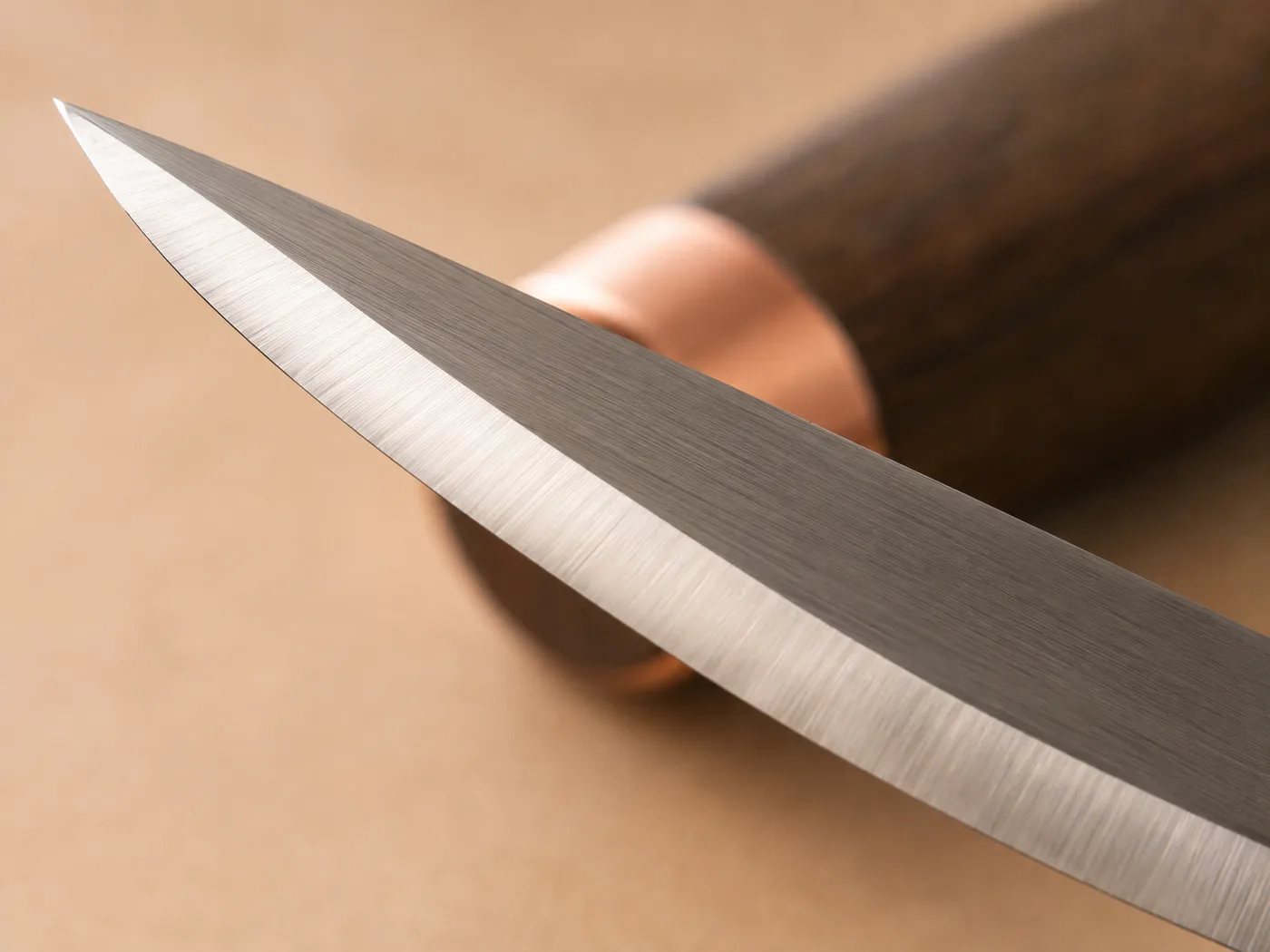
Steel is the first line on any carving knife spec sheet and the one most people skip, because the words on it — carbon, stainless, chrome vanadium, a number followed by HRC — sound like they belong to a metallurgist. They do not. Three ideas cover the subject: which family a steel belongs to, what that family trades away, and what a hardness number does and does not tell you. If you are still working out which blade shapes to start with, our beginner's guide covers the shapes; this one covers the metal.
Two families, and what "stainless" actually means
The line between the two families is written into the standard, not left to taste. Euro Inox, the European stainless steel development association, defines stainless as an iron alloy carrying at least 10.5 percent chromium and at most 1.2 percent carbon, the chromium being there to build the self-healing passive layer that gives the steel its corrosion resistance. Below that level no passive layer forms, and the steel is, in the everyday sense, carbon steel: it rusts if left wet, and it takes a polish, an edge and a strop the way carvers have relied on for centuries.
Carbon does the hardening in both families: heat the steel, quench it and the carbon locks the structure into something hard enough to hold an edge; temper it and you trade a little hardness back for toughness. The alloying elements shape how that hardness is arranged. In stainless, the large chromium content ties carbon up in coarse chromium carbides; in a low-alloy steel, small additions of chromium and vanadium refine the grain and form fine, hard carbides instead. The difference sounds academic until you put an edge on each and pull it across leather.
Why carvers have always leaned toward the carbon family
A carving knife does not chop, pry or meet bone; it slices wood fibers, thousands of times, at a shallow angle, and the very apex of the edge slowly rounds over. The fix, as our sharpening guide explains, is a strop loaded with polishing compound rather than a stone: light, edge-trailing strokes realign and polish the apex without grinding steel away. That works on any steel, and fastest on steels whose carbides are fine enough for the compound to bite evenly along the whole edge.
That is the carbon family's home ground. A plain carbon or low-alloy blade can be brought to a very fine apex and kept there with leather alone, which is why the traditional carving patterns — the Scandinavian sloyd, the Japanese kiridashi we took apart in our guide to Japanese carving knives — were ground from carbon steels long before stainless existed. The steel was chosen for the edge, and the care routine was built around the steel.
What stainless does well, and where that matters
None of this is a knock on stainless; it is what the chromium is for. A kitchen knife is washed a dozen times a day and left on a rack; a steel that shrugs that off is right for that job. A carving knife is used dry, wiped after green wood, rolled in canvas and stropped before it ever gets dull, so the corrosion resistance paid for in edge behaviour insures against a situation it rarely meets.
The trade is real in the hand: a stainless blade comes back on the strop, but it takes more strokes, and the very fine apex that leaves a glassy facet is harder to reach. The rule most carvers land on is simple: steel that will live around water, stainless; steel that will slice basswood and get stropped, the carbon family.
| Carbon family (including chrome vanadium) | Stainless | |
|---|---|---|
| Chromium | A small alloying addition, well below the stainless threshold | At least 10.5 percent, by the Euro Inox definition |
| Finest edge | Takes a very fine apex readily | Reaches a good edge; the finest apex is harder to raise |
| Strop response | Comes back in a minute on leather and compound | Comes back, with more strokes |
| Rust | Rusts if stored wet | Resists rust through its passive layer |
| Care | Wipe dry, store in the roll | Minimal |
| Where it belongs | Carving bench, workshop, canvas roll | Kitchen, boat, damp or salty air |
One caution: a table like this describes families, not individual blades. Heat treatment decides as much as composition — the family says what a steel can do, the treatment decides how much of it a blade delivers — which is why a blade is better judged by how it cuts and strops than by the name of its steel; more on that below.
Chrome vanadium: where it sits in the carbon family
The name sounds as though it belongs on the stainless side. It does not: the chromium in a chrome vanadium steel is a small alloying addition, not the protective quantity that defines stainless, and no passive layer forms at that level. Instead the chromium helps the steel harden evenly through its thickness and resist wear once hard, while the vanadium keeps the grain fine during heat treatment and locks some of the carbon into carbides so hard and so small that they sharpen the edge rather than coarsen it. The result behaves like a good carbon steel on the strop with a little more toughness underneath.
That toughness matters, because not every cut is a gentle slice along the grain. The hook knife spends its working life cutting across fibers to hollow a spoon bowl, which dulls any edge faster than slicing with the grain; a chip carving knife is levered, gently, to pop a chip free; a stop cut is pushed straight into end grain. A steel hard enough to hold a fine apex and tough enough not to chip when the cut turns awkward is the one you want on all five blades.
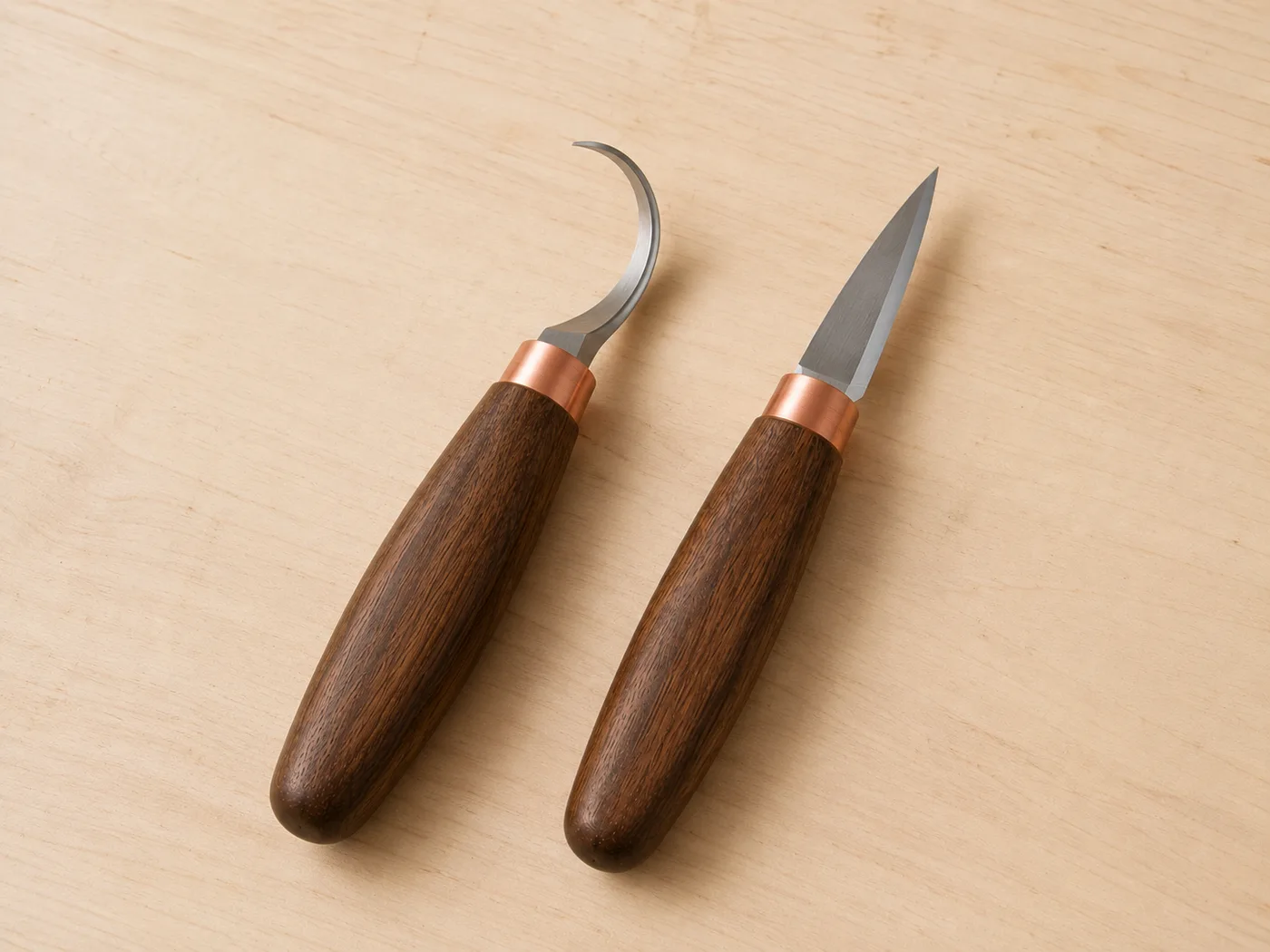
It is the steel the five blades in the CarveKind kit are ground from — sloyd, chip carving, hook, oblique and trimming, each on a square black walnut handle. A verified buyer in Denmark noted that the "blades are made of thick steel"; one in Canada put it as "Very sharp. Steel seems good quality." The one habit the family asks for in return is the wipe-down: no carbon-bearing tool steel likes being stored damp, so thirty seconds with a dry cloth after carving green wood is the whole cost of the sharper edge.
Average rating across 192 verified buyer reviews of the CarveKind kit
— CarveKind verified buyer data, 2026
What HRC really means
The definition is public. The National Institute of Standards and Technology's practice guide for Rockwell hardness describes the C scale as a spheroconical diamond indenter with a 120-degree cone angle, applied with a preliminary force of 10 kilograms-force and a total force of 150 kilograms-force, the hardness being calculated from the difference in indenter depth between the two. A result carries the scale with it — 64 HRC, in the guide's own example — and the scale is meant for steel and other hard materials, with a recommended range of roughly 20 to 70 HRC. Higher is harder: the diamond sank less.
What the number tells a carver is real but narrow: hardness correlates with how long an edge resists wearing down and how thin an apex the steel can support before it folds, so of two blades of the same steel and geometry, the harder one usually holds its edge longer. What it does not tell you is most of what decides whether a knife carves well: nothing about toughness, where a very hard steel chips and a slightly softer one rolls and strops back; nothing about carbide structure, which governs how fine an edge the steel takes; nothing about edge geometry or whether the heat treatment was consistent along the blade. It is also, by the guide's own account, a measurement of one spot: hardness varies across a surface, and a Rockwell test at a given point can be made only once. A number with no note of who measured it, where and how many times is one to read with care.
Harder is not the same as better for a carving edge
This is what gets lost when hardness is treated as a score. A higher number is not free: the structure that resists a diamond also resists a strop, so the harder a blade is, the more strokes it takes to bring the apex back and the more likely a chip is to need a stone rather than leather. For a carving knife stropped every twenty or thirty minutes of work — the routine on our leather strop and compound page — a steel that answers to leather quickly is more useful than one that resists it.
There is a safety dimension too. An edge that rolls slightly is still an edge; an edge that chips leaves a notch that catches in the cut, and a catching blade is how hands end up in front of the edge. These are adult tools, or tools for closely supervised teens, and cutting away from the body does not change with the steel.
What to judge instead of a hardness number
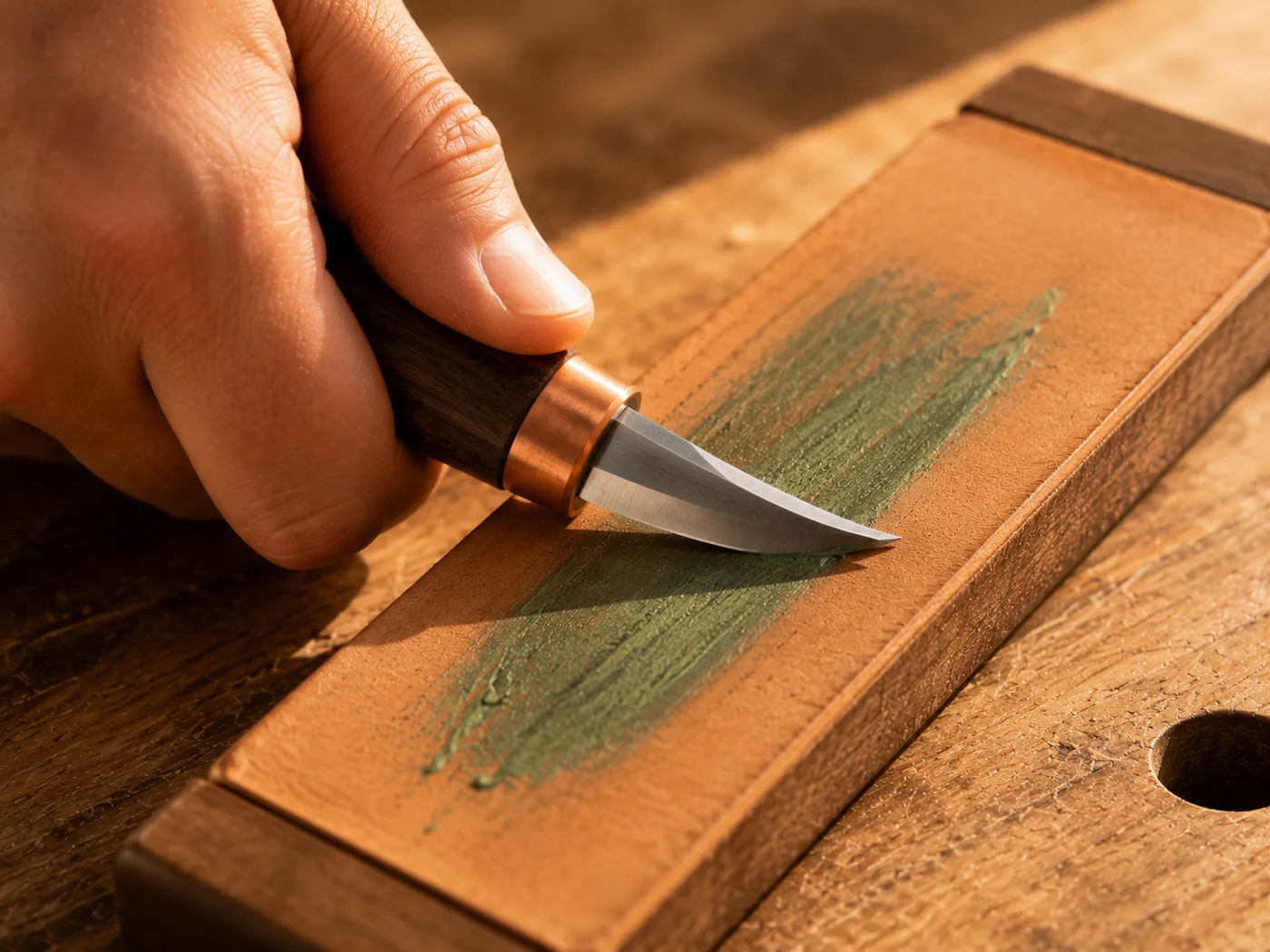
The reason is the previous two sections. A hardness figure would be one line, measured at one spot, about one property; what a carver needs to know is how the edge behaves in wood and on leather, and that is something you can check with the kit as sold: carve until the edge begins to drag, strop it with the green polishing wax on the grinding leather, then see how completely the bite returns and how long it holds before the next touch-up.
Read that way, the steel question becomes one you can check. Does the edge arrive sharp? Verified buyers on our reviews page say so consistently. Does it come back on the strop? That is the routine the kit was assembled around, which is why the strop and compound ship in the same roll as the five blades. Does it survive an awkward cut without chipping? That is the toughness the chrome vanadium family is used for. Those three answers are the steel spec that matters.
Choosing a carving knife by its steel comes down to one question: what will the blade be asked to do, and where will it live? A blade that lives dry, slices wood and gets stropped is a carbon-family blade, and chrome vanadium is that family with extra toughness under the edge. The five chrome vanadium blades come with the leather strop, the green polishing wax and the canvas roll that keep them keen and dry in the CarveKind 8-piece kit, at $39.95 against a $59.95 compare price, with free shipping and a 30-day money-back guarantee.
Share of US orders delivered within 11 business days, with free shipping
— Verified delivery data, 2026
Carving knife steel FAQ
Is chrome vanadium steel stainless?
No. Chrome vanadium is a low-alloy steel in the carbon family: it carries a small chromium addition for hardenability and wear resistance, far below the 10.5 percent minimum that defines a stainless steel. That is why it takes a keen edge and comes back quickly on a strop, and also why it should be wiped dry after carving green wood and stored in the canvas roll rather than a damp drawer.
Is carbon steel or stainless steel better for a wood carving knife?
For carving, the carbon family. A carving edge is thin, worked in long slicing cuts and touched up on leather every session, and carbon and low-alloy steels take that fine edge more readily and strop back faster. Stainless trades some of that edge behaviour for corrosion resistance, which matters where a blade lives wet. A carving knife lives dry, in a roll, so the trade goes the other way.
What HRC should a wood carving knife be?
Treat a Rockwell number as one line on a spec sheet rather than the verdict. HRC records how far a diamond point sank into the steel under a set load at one spot; it does not measure toughness, edge geometry or how the blade responds to a strop. Judge a carving knife by what it does: whether it arrives sharp, takes clean slicing cuts and comes back on leather in a minute.
Will chrome vanadium carving knives rust?
Any steel in the carbon family can, if it is stored damp. It does not happen on a bench where the blades are wiped after use and rolled in canvas between sessions: thirty seconds with a dry cloth after carving green wood covers it, and a blade that is stropped every session is looked at every session, so nothing sits unnoticed.

Cole Harmon · Hobbyist Woodcarver & Hand-Tool Reviewer, 8 yrs
Cole has spent eight years carving with hand tools — sloyd knives, hook knives, strops and sharpening gear.
Written by Cole Harmon.