· Cole Harmon
Japanese Wood Carving Knives: Kiridashi and What Makes Them Different
Carvers meet the word kiridashi the same way every time: someone posts a photo of a short, plain blade with a slanted end, the replies fill with people saying it changed how they lay out a cut, and nobody explains what is different about it. The answer is not romance and it is not steel. It is geometry — one bevel instead of two, and a tip cut off at a slant instead of brought to a symmetrical point — and once you see it you can predict what the blade will do. If you are still choosing your first blades, the beginner's guide to wood carving is the place to start.
What a kiridashi actually is
Strip away everything decorative and a kiridashi is a rectangle of steel with one corner taken off. No swelling in the blade, no belly to the edge, no drop to the point. The back face is dead flat for its whole length, the front face carries the grind, and the slanted end turns the meeting of those two faces into one long cutting edge finishing in a very acute corner. That corner is the working part.
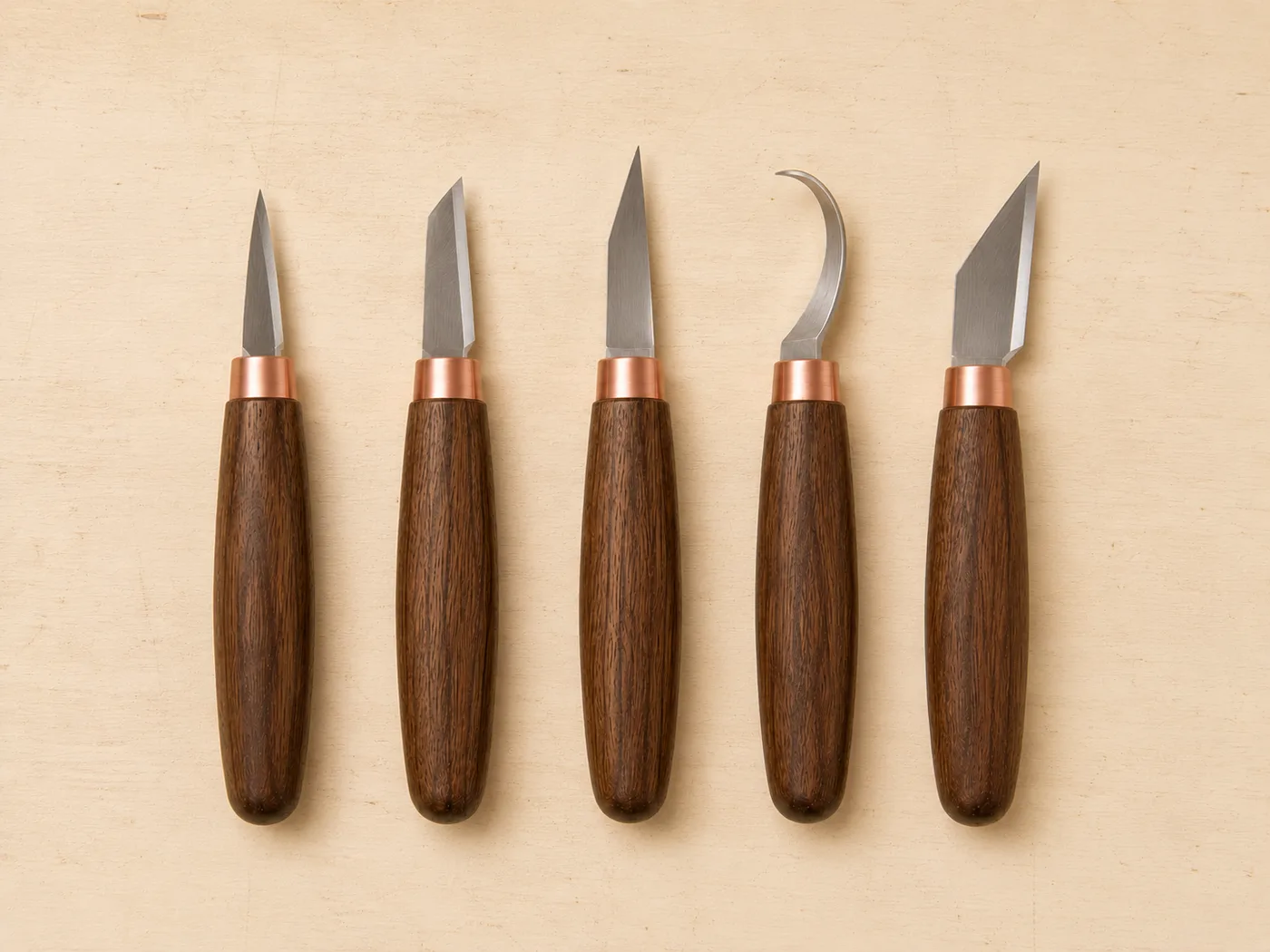
The handle tells the same story. Many kiridashi have barely any handle at all — the steel simply continues, sometimes wrapped in cord or bark. A blade used for marking gets pinched close to the edge and steered with fingertips, so a thick round grip would push the hand away from where control is needed. Set that against the square black walnut handles on the five knives in our kit, shaped to be held in a full hand and pushed: a different job produces a different handle.
What you will not find here is a bevel angle, a hardness figure or a steel designation: those vary from one smith to the next. The geometry is the same on every kiridashi ever made, and the geometry is what changes the cut.
One bevel instead of two: the geometry that defines it
Hold a double-bevel carving knife against a board and the edge sits on the centerline, steel angling away on both sides. Push it in and the wood is displaced equally left and right, so the blade goes where you aim it and leaves a symmetrical V. That neutrality is what you want when a knife is shaping a form: your hand decides the direction and the blade does not argue.
A single bevel is deliberately not neutral. All the metal thickness sits on one side of the edge, so the wood pushes back unevenly and the blade drifts toward the flat face. Held with that face against a line, the drift stops being a fault and becomes the feature: the blade is pressed against its reference and cuts a wall standing perpendicular to the surface, with the waste peeled off to the bevelled side. The cut has a finished face and a rough face, and you choose which is which.
The slanted tip, and the line it leaves
A symmetrical point is buried in the middle of the blade, so steel on both sides of it hides the wood you are about to cut. Move the point to the corner and it emerges from behind the blade: you can see the mark, you can see the tip, and you can put one on the other without leaning around your own hand. Anyone who has tried to start a stop cut on a pencil line with the point buried mid-blade knows how much of that job is guesswork made necessary by the geometry.
The slant does something else. Because the edge rises away from the tip in a straight ramp, the knife can be laid flat against a square and drawn along it, scoring a line at a controlled depth in one pass. That line is then a physical wall rather than a graphite smudge, and every later cut has something to register against. Direction still governs everything: a scribed line crossing the fibers behaves differently from one running along them, which is why our grain direction guide is the companion piece.
Kiridashi, sloyd and whittling knife, side by side
Half the confusion here is that the three words do not sit on the same axis: two name a tradition and a pattern, one names a category of use. Laid out by what the steel is shaped to do, the picture is simpler.
| Blade | Edge geometry | Where the point sits | What it is built to do |
|---|---|---|---|
| Kiridashi | Single bevel, one flat reference face | At one corner, on a slant | Scribing layout lines, paring to a line, fine detail |
| Sloyd knife | Double bevel, straight edge along the blade | On the centerline | Roughing to shape, long slicing cuts, general whittling |
| Oblique knife | Double bevel, edge carried at an angle | Forward, at the end of the slant | Incised lines, corners, angled detail cuts |
| Chip carving knife | Double bevel, short blade held low | On the centerline, close to the hand | Geometric patterns, borders, lettering chips |
| Hook knife | Double bevel on a swept curve | At the end of the curve | Hollowing spoon bowls, cups and small dishes |
Read down the last column and the division of labor is obvious. One row defines where wood will be removed; three rows remove it. One removes it from a concave surface — the job a straight edge cannot reach, and the reason the hook knife exists. A workshop that carves objects uses the removal rows every session.
The vocabulary trips up more beginners than the geometry does. "Whittling" and "carving" get used as if they were separate crafts, and our whittling knife page takes that apart properly; the short version is that whittling is carving done with the work in hand rather than clamped down, and the sloyd is the blade the word usually means.
The cuts each blade is built for at the bench
Watch someone carve a spoon and you can time the phases. Laying out the profile needs precision rather than power. Roughing the blank down to it needs a blade you can lean on, with a handle that fills your palm. Hollowing the bowl needs a curve. Refining facets and cleaning the rim needs a small, controlled edge and very little force. Four phases, four demands on the steel.
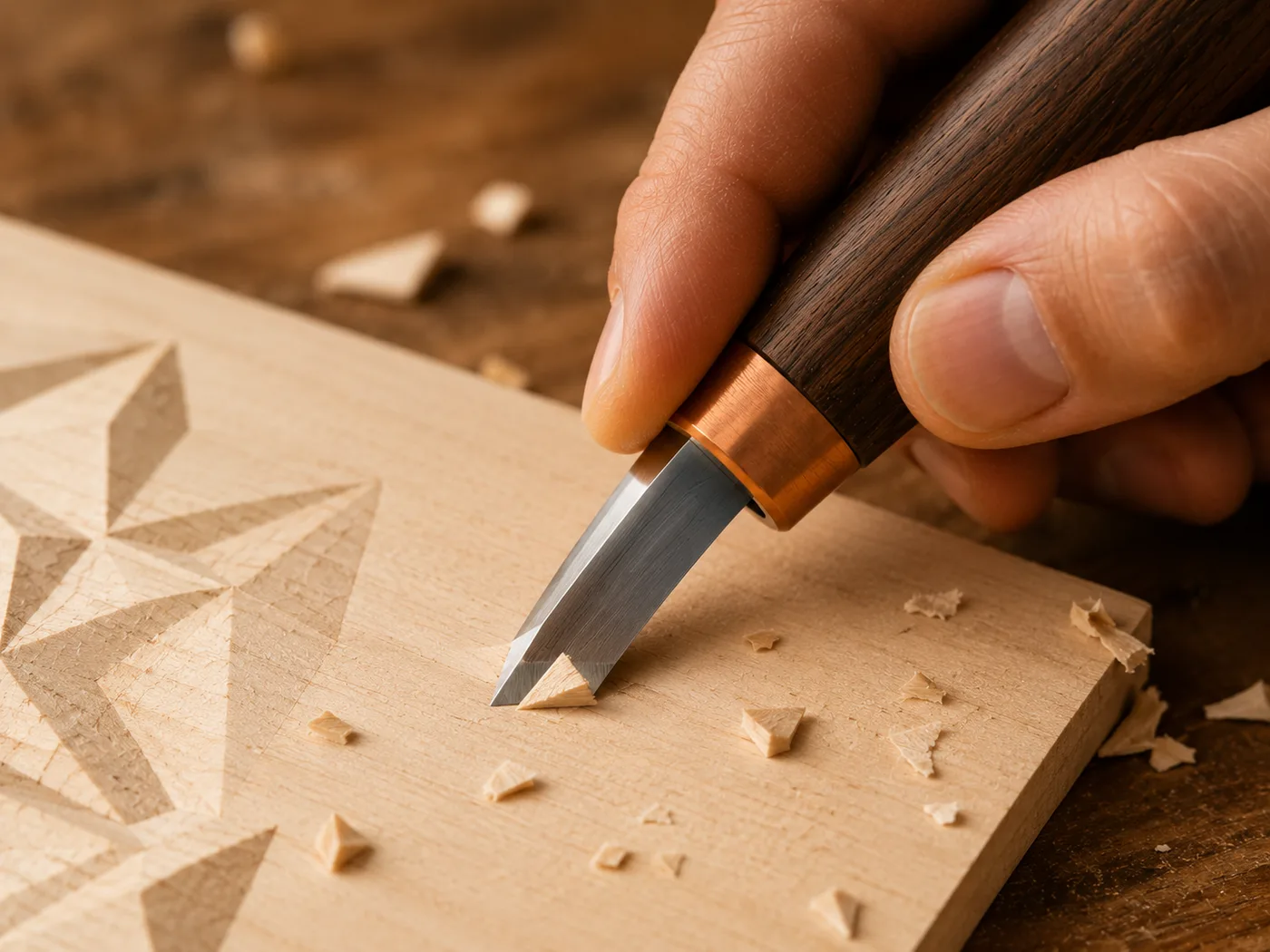
Against those phases, the kiridashi's home ground is narrow and real: the line. It comes into its own on flat work — chip carving patterns, incised decoration, lattice work, joinery layout — where the project is built from lines cut to a mark and waste pared up to them. In three-dimensional carving the same skill appears in the stop cut that halts a facet exactly where you meant it to stop.
Which is why a kiridashi sits alongside a carving set rather than in place of one. The more useful half of that for anyone building a first kit is the reverse: a set that already includes a dedicated line-and-detail blade has the layout job covered, which is what the oblique and trimming knives are doing in the CarveKind roll.
The blade in the kit that shares the most geometry
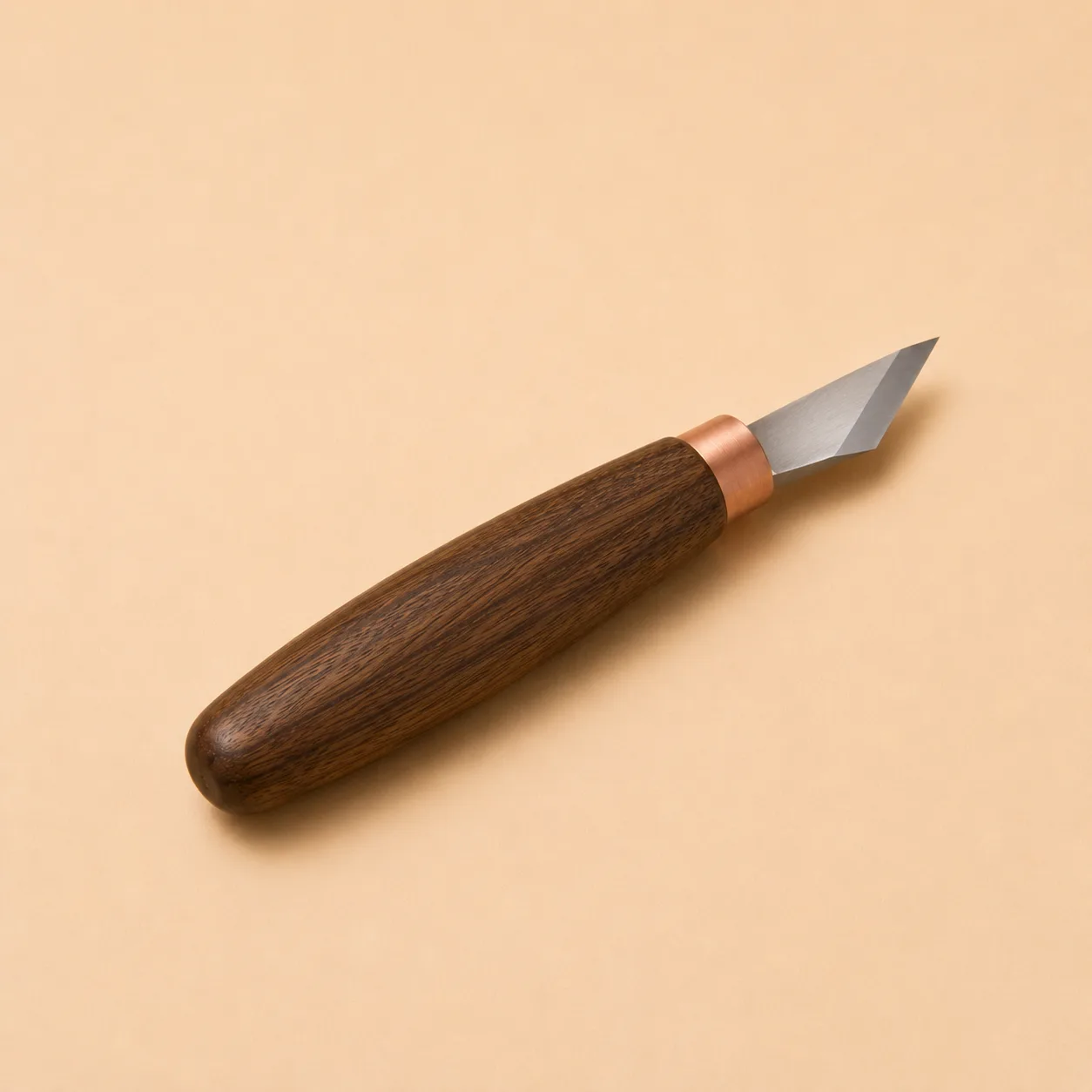
Put the two side by side and the resemblance is in the silhouette: a long straight edge running up to a point that sits at the leading corner rather than in the middle of the blade. Both put the tip where the eye is, and both are worked with the edge riding along a line rather than plunging across a surface. What differs is the bevel — the oblique is ground on both faces, so it cuts a symmetrical incision and steers wherever you point it in either hand.
That decides which one you reach for. A crisp V-groove of incised decoration, the outline around a chip-carved rosette, the junction where two planes of a carving meet — those want an edge that cuts evenly on both sides, and that is the oblique's day job.
Grip is the other half. Detail cuts are low-force and want fingertips close to the edge; shaping cuts want a handle that spreads the load across a whole palm. A verified CarveKind buyer in Korea put that side of it plainly: "When cutting wood, the blade is sturdy and the large handle is comfortable for applying force."
Average rating across 192 verified buyer reviews of the CarveKind kit
— CarveKind verified buyer data, 2026
Sharpening an asymmetric edge, and the routine underneath
The mistake that ruins a single-bevel blade is rounding that flat face to chase a burr: once it is convex, it registers against nothing.
Double-bevel carving blades are more forgiving day to day and the routine is faster: a minute on leather charged with polishing compound realigns and polishes an edge without grinding steel away, alternating faces and keeping each bevel flat. That is the habit the leather strop and green polishing wax in the kit support, and our sharpening guide walks the full routine. A keen edge is also the safe one, because it goes where you point it instead of skating — and every guide on this site assumes you cut away from your body, keep the holding hand behind the edge's path, and treat these as adult tools or ones used under close supervision.
Learning a blade by its geometry rather than by its name transfers to every tradition. One bevel or two, point on the centerline or at the corner, straight edge or swept curve: those three questions tell you what any carving blade will do before you have made a single cut with it. The five chrome vanadium blades that cover the shaping, hollowing, pattern and detail work — sloyd, chip carving, hook, oblique and trimming — come with the leather strop, the green polishing wax and the canvas roll in the CarveKind 8-piece kit, at $39.95 against a $59.95 compare price, with free shipping and a 30-day money-back guarantee.
CarveKind carving kits sold to date
— CarveKind sales data, 2026
Japanese wood carving knife FAQ
What is a kiridashi knife used for?
Layout and detail. A kiridashi scribes the lines a woodworker cuts to, pares small amounts of waste up to those lines, and handles fine detail where the tip has to arrive exactly on a mark. Because one face of the blade is flat, it can be held against a straightedge and referenced off it, which is the trick that makes the line land where it was drawn.
What is the difference between a kiridashi and a sloyd knife?
The bevel and the job. A kiridashi is ground on one face only and ends in a slanted tip, so it excels at cutting a line and working fine detail. A sloyd carries a bevel on both faces and a straight edge running the length of the blade, which is what lets it rough a blank down to shape and take the long slicing cuts most of a carving session is made of.
Are single-bevel Japanese knives made for right-handed carvers?
Usually, yes. A blade bevelled on one face only is not symmetrical, so it steers slightly toward the flat side and suits one hand rather than either, which is why single-bevel patterns come in right-handed and left-handed versions. A double-bevel carving knife has no handedness at all: the five blades in the CarveKind kit work the same in either hand.
Do you sharpen a single-bevel knife differently from a carving knife?
The principle is the same, the routine is not. On a single bevel the flat face is a reference surface and stays flat, so almost all the work happens on the bevelled face and the flat side gets only the lightest pass to lift the burr. A double-bevel carving knife is stropped on both faces in turn, keeping the factory bevel flat on the leather — the routine our sharpening guide walks through with the strop and green polishing wax included in the kit.

Cole Harmon · Hobbyist Woodcarver & Hand-Tool Reviewer, 8 yrs
Cole has spent eight years carving with hand tools — sloyd knives, hook knives, strops and sharpening gear.
Written by Cole Harmon.